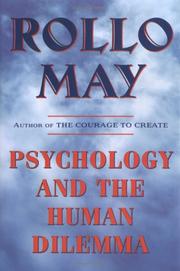
The development of an existential psychology in America is in good part the work of Rollo May. He helped bring existentialism to psychology some fifteen years ago, and since then his impact has increased each year. As he says here, he isn't an existentialist in a cultist sense. In American psychology, the existential approach is part of a wider trend which includes many views" (Eugene T. Gendlin, Psychology Today). May's psychology is sometimes referred to as humanistic. He is one of the affirmative, "third force" American psychologists who are also critical of the society in which we live. Gendlin writes further: "In. . . Psychology and the Human Dilemma [1966], May offers a wealth of valid and stimulating ideas in a totally engaging and readable fashion. [The human dilemma is that] man is always both an active subject and a passive object ". . . May [says]: "Only in knowing ourselves as the determined ones are we free. This last sentence and his many similar discussions seem to mean that we can't help what happens, but only what attitude we take toward what happens. In fact, he means more than this---in taking an attitude toward what happens we change what happens." In late 1968, May was the subject of an article in the New York Times in which he was said to feel that "one sign that the modern age is dying is that its myths are dying." We are at present in a "limbo" between myths---the situation in which people become disoriented and "alienated." "In the new myths," he said, "I would think that racial variation will be seen as a positive value, that emphasis on one world will replace fragmented nationalism, and that things will be valued more for their intrinsic worth rather than in use---what they can be banked for.
Reading Progress
Sign in to track your current chapter and mark books as completed.
Links
No reading links have been added for this book yet.
People Also Recommend
No popular bookshelves include this book yet.
Community Reviews
Sort by:
Want to share your thoughts?
Join the community to rate and review your favorite stories.
No reviews yet. Be the first to share your thoughts!
Use this form for metadata problems, missing links, or anything that does not fit the dedicated genre and tag suggestion boxes. Admins will review it before changing the live page.