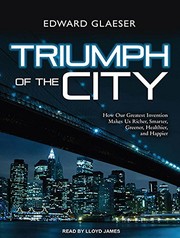
**A pioneering urban economist offers fascinating, even inspiring proof that the city is humanity's greatest invention and our best hope for the future.**
America is an urban nation. More than two thirds of us live on the 3 percent of land that contains our cities. Yet cities get a bad rap: they're dirty, poor, unhealthy, crime ridden, expensive, environmentally unfriendly... Or are they?
As Edward Glaeser proves in this myth-shattering book, cities are actually the healthiest, greenest, and richest (in cultural and economic terms) places to live. New Yorkers, for instance, live longer than other Americans; heart disease and cancer rates are lower in Gotham than in the nation as a whole. More than half of America's income is earned in twenty-two metropolitan areas. And city dwellers use, on average, 40 percent less energy than suburbanites.
Glaeser travels through history and around the globe to reveal the hidden workings of cities and how they bring out the best in humankind. Even the worst cities-Kinshasa, Kolkata, Lagos- confer surprising benefits on the people who flock to them, including better health and more jobs than the rural areas that surround them. Glaeser visits Bangalore and Silicon Valley, whose strangely similar histories prove how essential education is to urban success and how new technology actually encourages people to gather together physically. He discovers why Detroit is dying while other old industrial cities-Chicago, Boston, New York-thrive. He investigates why a new house costs 350 percent more in Los Angeles than in Houston, even though building costs are only 25 percent higher in L.A. He pinpoints the single factor that most influences urban growth-January temperatures-and explains how certain chilly cities manage to defy that link. He explains how West Coast environmentalists have harmed the environment, and how struggling cities from Youngstown to New Orleans can "shrink to greatness." And he exposes the dangerous anti-urban political bias that is harming both cities and the entire country.
Using intrepid reportage, keen analysis, and eloquent argument, Glaeser makes an impassioned case for the city's import and splendor. He reminds us forcefully why we should nurture our cities or suffer consequences that will hurt us all, no matter where we live.
(*Source: Penguin Press blurb*)
Reading Progress
Sign in to track your current chapter and mark books as completed.
Links
No reading links have been added for this book yet.
People Also Recommend
No popular bookshelves include this book yet.
Community Reviews
Sort by:
Want to share your thoughts?
Join the community to rate and review your favorite stories.
No reviews yet. Be the first to share your thoughts!
Use this form for metadata problems, missing links, or anything that does not fit the dedicated genre and tag suggestion boxes. Admins will review it before changing the live page.